Classic Baked Cheesecake
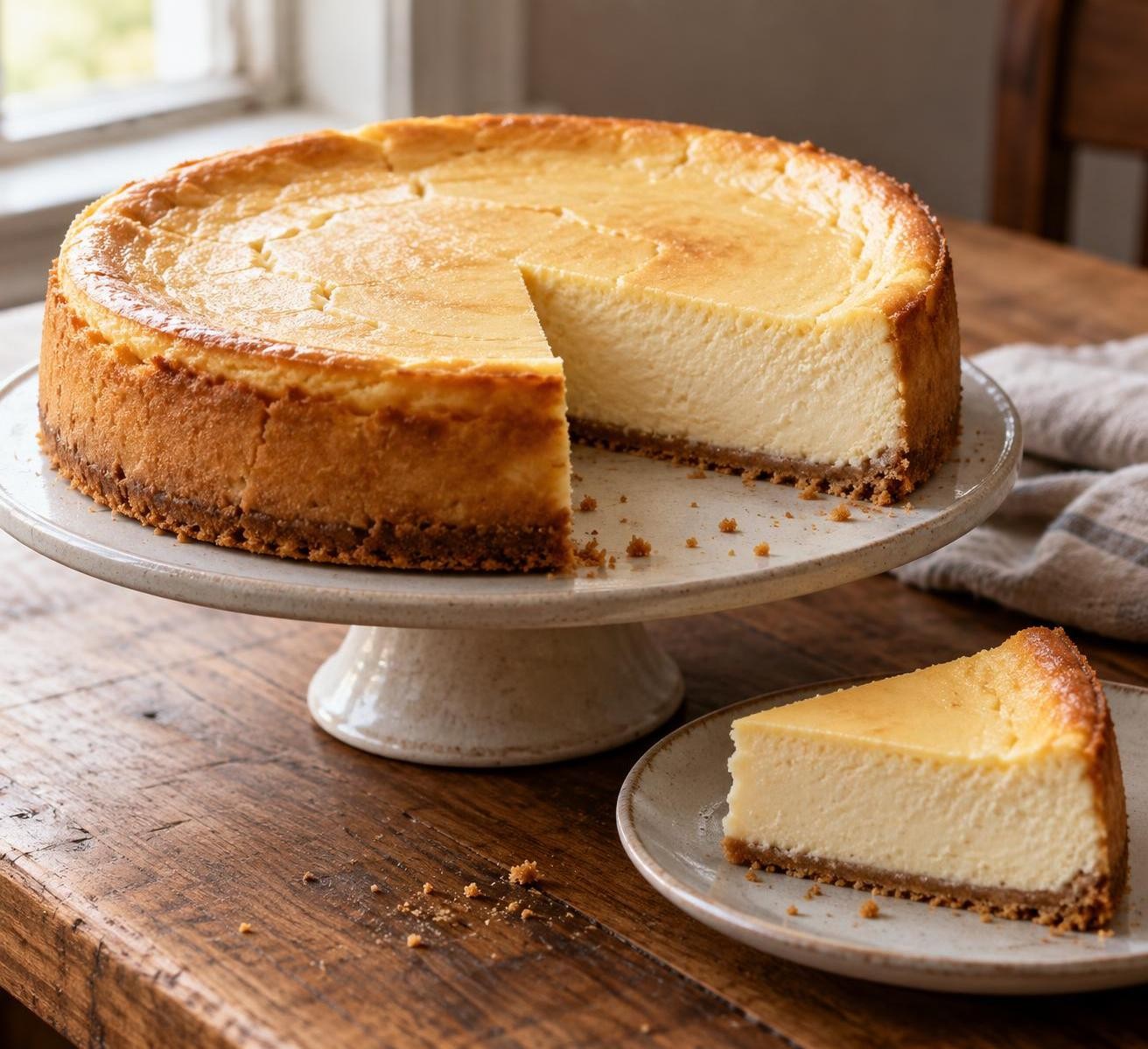
A tall, dense, creamy New York-style baked cheesecake with a buttery graham crust — no cracks, thanks to a low oven and a water bath.
I resisted baked cheesecake for a long time because the first one I ever made cracked right down the middle like a dry riverbed. I had cranked the oven, opened the door too early, and yanked it out the second the timer went off. It tasted fine, but it looked like a disaster, and I decided cheesecake and I were not friends.
What finally won me over was learning that cheesecake is not really baked so much as gently set. It wants a low, patient oven, a pan of hot water for humidity, and to be left completely alone. The cracks I kept getting were the cake telling me I was rushing it — too much air whipped into the batter, too hot an oven, too fast a cool-down.
Now I beat the cream cheese soft first so there are no lumps, add the eggs last and only just until combined, and bake it low in a water bath. When the timer goes off, the centre should still have a slight wobble, like set jello. Then I turn the oven off, crack the door, and let it cool down slowly in there before it ever meets the counter.
It needs a night in the fridge to become itself — dense, cool, and impossibly creamy. This is the one I bring to family dinners now, tall and smooth on top, and nobody remembers the cracked one but me.
At a glance
- Prep
- 25 min
- Cook
- 75 min
- Total
- 100 min
- Yield
- One 9-inch cheesecake (12 slices)
- Difficulty
- Medium
Ingredients
- **For the crust:**
- 200g graham cracker crumbs (about 14 full crackers)
- 50g granulated sugar
- 90g butter, melted
- **For the filling:**
- 900g (four 8-oz blocks) full-fat cream cheese, room temperature
- 200g granulated sugar
- 3 Tbsp all-purpose flour or cornstarch
- 4 large eggs, room temperature
- 120ml sour cream, room temperature
- 120ml heavy cream, room temperature
- 2 tsp pure vanilla extract
- 1 Tbsp lemon juice
- Pinch of fine salt
Method
-
Preheat the oven to 160°C (325°F). Wrap the outside of a 9-inch springform pan in two layers of heavy-duty foil to keep water out during the bath.
-
Make the crust: Stir the graham crumbs, sugar, and melted butter together until it looks like wet sand. Press firmly into the bottom of the pan and slightly up the sides. Bake for 10 minutes, then set aside to cool while you make the filling.
-
Beat the cream cheese on medium-low until completely smooth and lump-free, scraping the bowl often. Add the sugar and flour and beat until combined. Keep the speed low from here — you do not want to whip in air, which causes cracks.
-
Add the eggs one at a time, mixing on low just until each disappears. Mix in the sour cream, heavy cream, vanilla, lemon juice, and salt until the batter is smooth and glossy. Do not overbeat.
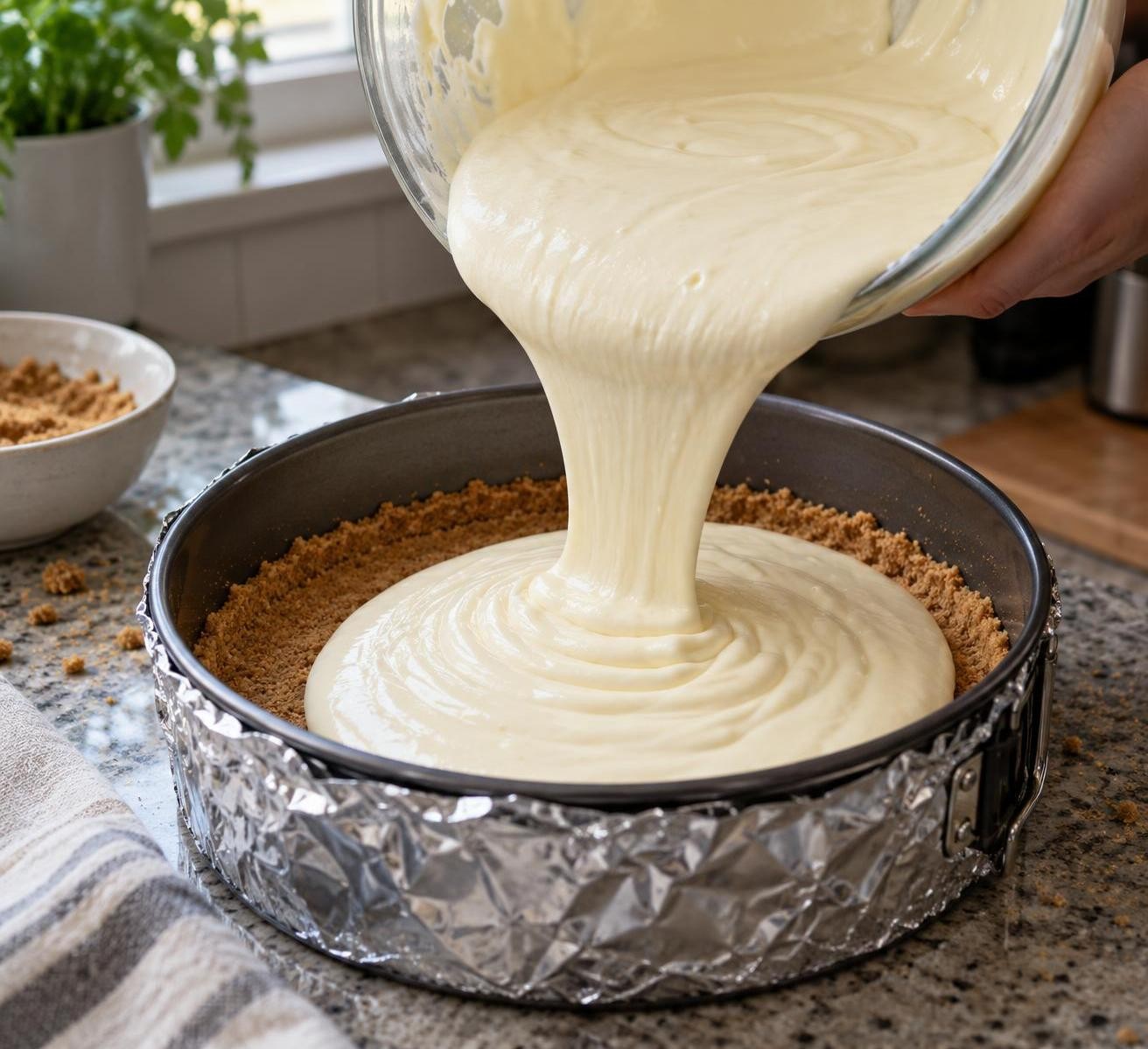
Keep the batter smooth and glossy without whipping in extra air. -
Pour the batter over the cooled crust and smooth the top. Set the springform pan into a larger roasting pan and pour hot water into the roasting pan until it reaches about halfway up the sides of the springform.
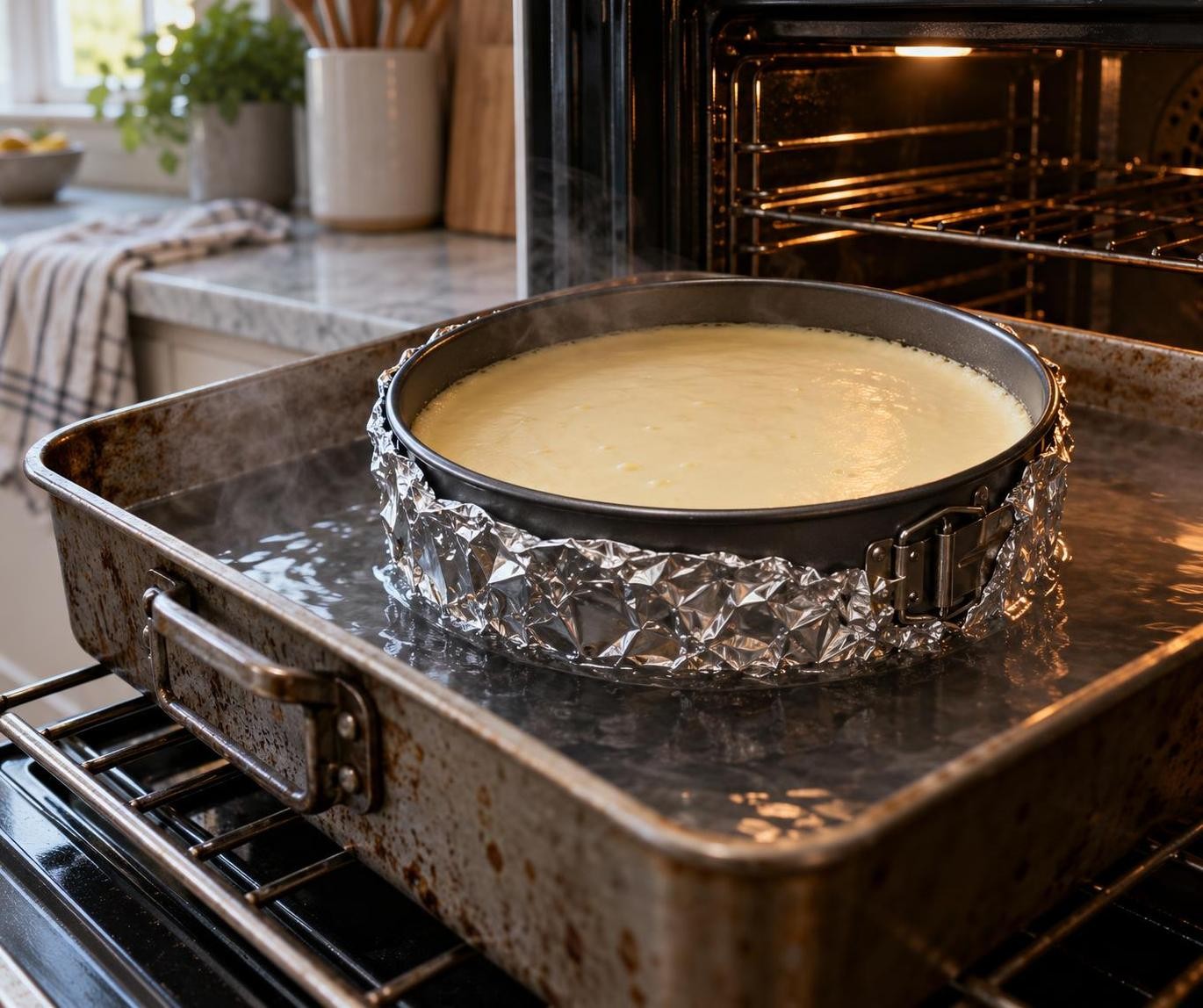
The water bath keeps the bake gentle and humid. -
Bake for 65 to 80 minutes. The edges should be set but the centre 3 to 4 inches should still jiggle slightly when you nudge the pan — it will firm up as it cools.
-
Turn the oven off, prop the door open with a wooden spoon, and let the cheesecake cool in the oven for 1 hour. This slow cool-down prevents cracks.
-
Remove from the water bath, run a thin knife around the edge to release it from the pan sides, and let cool to room temperature. Refrigerate uncovered for at least 6 hours, ideally overnight, before unmolding and slicing.
Tips & Swaps
- Room temperature cream cheese is non-negotiable — cold cream cheese leaves lumps you can never fully beat out.
- Keep the mixer on low once the sugar goes in. Air bubbles are the number one cause of cracks and a puffy, sinking top.
- The water bath keeps the oven humid and the temperature gentle, which is what gives you that smooth, dense texture.
- Do not overbake. A slight wobble in the centre at the end is correct — a fully firm centre means it is already overdone.
- Wipe your knife clean and dip it in hot water between slices for clean, bakery-neat cuts.
Nutrition
Per serving · 1 slice
- Calories
- 480 kcal
- Fat
- 35 g
- Saturated fat
- 20 g
- Cholesterol
- 150 mg
- Sodium
- 340 mg
- Carbs
- 34 g
- Fiber
- 1 g
- Sugar
- 26 g
- Protein
- 8 g
Estimated values, calculated per serving. Actual nutrition varies with ingredients and portion sizes.