Silky Steamed Egg (Cantonese Water Egg)
A trembling, custard-smooth bowl of steamed egg — the gentle Cantonese comfort dish my family makes when someone needs a little looking after.
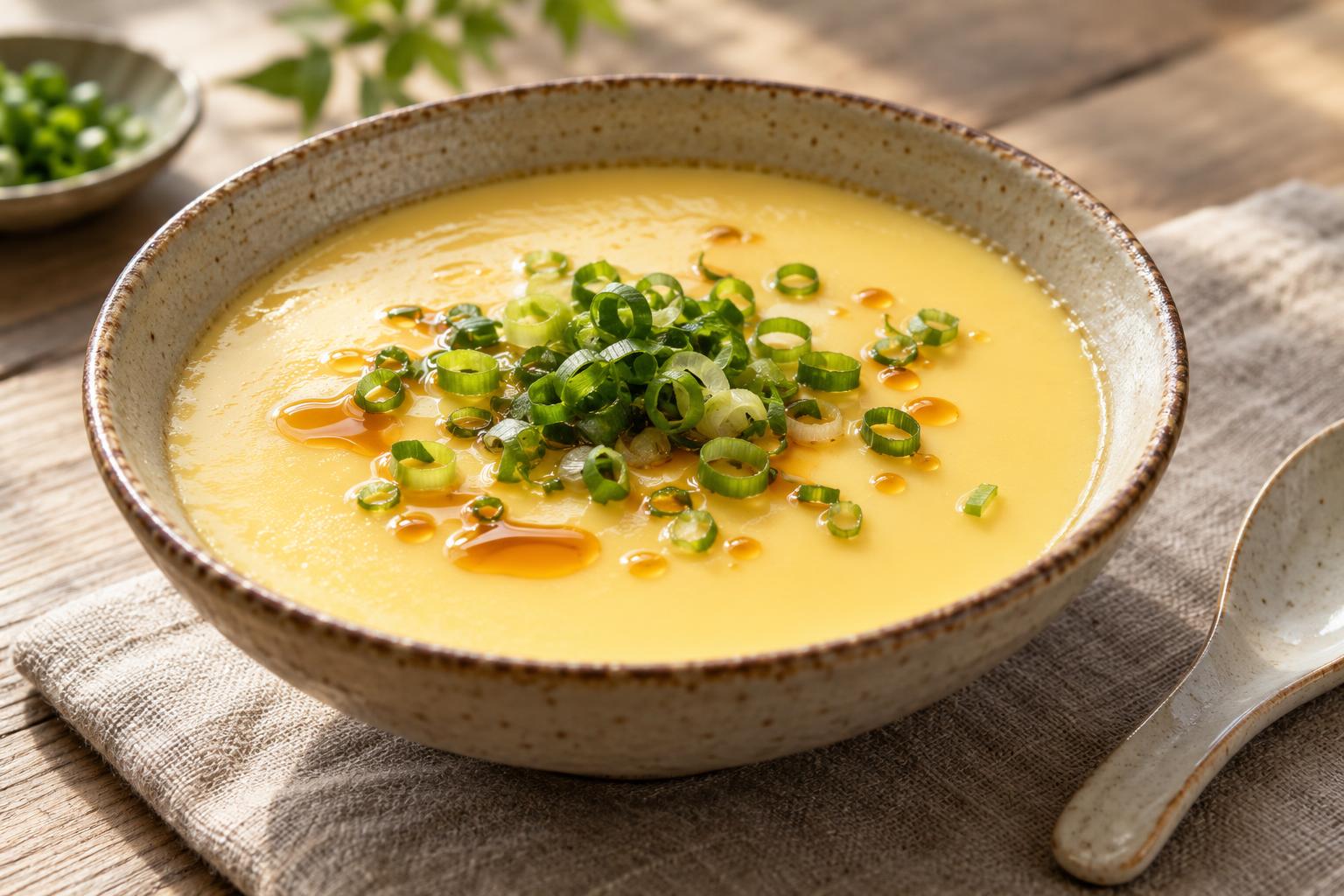
Steamed egg — sometimes called water egg, or zing daan — is one of those dishes that seems too simple to be special until you have eaten a really good bowl of it. When it is done right, the surface is as smooth and glossy as flan, and a spoon slides through into something silky and just barely set. It is the taste of being unwell as a kid and having my mom bring me a warm bowl to eat in bed.
You would think three ingredients could not go wrong, but they can, and mine did for a long time. My steamed eggs came out full of holes and bubbles, spongy and firm like an overcooked omelette, nothing like the custard I remembered. It turns out steaming egg is all about gentleness — gentle mixing, gentle heat, and getting rid of every bubble.
The details that fixed it: use warm water, not cold, and measure it against the eggs by volume. Strain the mixture so it is perfectly smooth. Skim off the foam, then cover the bowl so no dripping condensation pockmarks the top. And most importantly, steam it on low heat — a hard, rolling steam is what turns silk into sponge.
Finish it with a drizzle of soy sauce and sesame oil, maybe a scatter of green onion, and eat it over rice. It is humble and quiet and completely comforting, and I make it now for the people I love when they are having a hard day.
At a glance
- Prep
- 5 min
- Cook
- 12 min
- Total
- 17 min
- Yield
- 2 servings (with rice)
- Difficulty
- Easy
Ingredients
- 3 large eggs, room temperature
- Warm water (about 1.5 times the volume of the beaten eggs; roughly 240ml)
- 1/4 tsp salt
- **To finish:**
- 1 to 2 tsp light soy sauce
- 1/2 tsp sesame oil
- 1 stalk green onion, finely chopped
Method
-
Crack the eggs into a bowl and beat gently with the salt until the yolks and whites are just combined. Try not to whip in air — you want it mixed, not frothy.
-
Measure the beaten eggs, then add about 1.5 times that volume of warm (not hot, not cold) water. Stir gently to combine. The warm water helps the custard set smoothly and evenly.
-
Strain the egg mixture through a fine sieve into a shallow heatproof bowl. Skim off any foam or bubbles on the surface with a spoon — bubbles become holes.
-
Cover the bowl with a plate or a piece of foil. This stops condensation from dripping onto the surface and pockmarking it.
-
Set up a steamer with simmering water. Place the covered bowl in the steamer and steam over low to medium-low heat for 10 to 13 minutes. Low heat is the whole secret — a hard boil makes the egg spongy and full of holes.
-
The egg is done when the surface is set and glossy and only the very centre gives a slight jiggle when you nudge the bowl. If it is still liquid in the middle, cover and steam a couple more minutes.
-
Uncover carefully. Drizzle with light soy sauce and sesame oil, scatter the green onion over the top, and serve warm over rice.
Tips & Swaps
- Use warm water, not cold, and measure it by volume against the eggs — roughly 1.5 parts water to 1 part beaten egg gives that silky, just-set custard.
- Strain the mixture and skim the foam. Straining removes stringy bits and skimming removes bubbles, which is what gives the glassy-smooth surface.
- Steam on low heat. High heat is the single biggest reason steamed egg turns out bubbly and spongy instead of silky.
- Always cover the bowl while steaming so condensation does not drip onto the surface and leave craters.
- For extras, stir in a splash of chicken stock instead of some of the water, or nestle in a few small shrimp or a spoonful of minced pork before steaming.
Nutrition
Per serving · 1 serving
- Calories
- 120 kcal
- Fat
- 8 g
- Saturated fat
- 3 g
- Cholesterol
- 280 mg
- Sodium
- 500 mg
- Carbs
- 1 g
- Protein
- 10 g
Estimated values, calculated per serving. Actual nutrition varies with ingredients and portion sizes.