
Chinese Bakery Swiss Roll
The moist, cottony Swiss roll from the Chinese bakery case — a soft chiffon sponge rolled around lightly sweetened cream that never cracks.
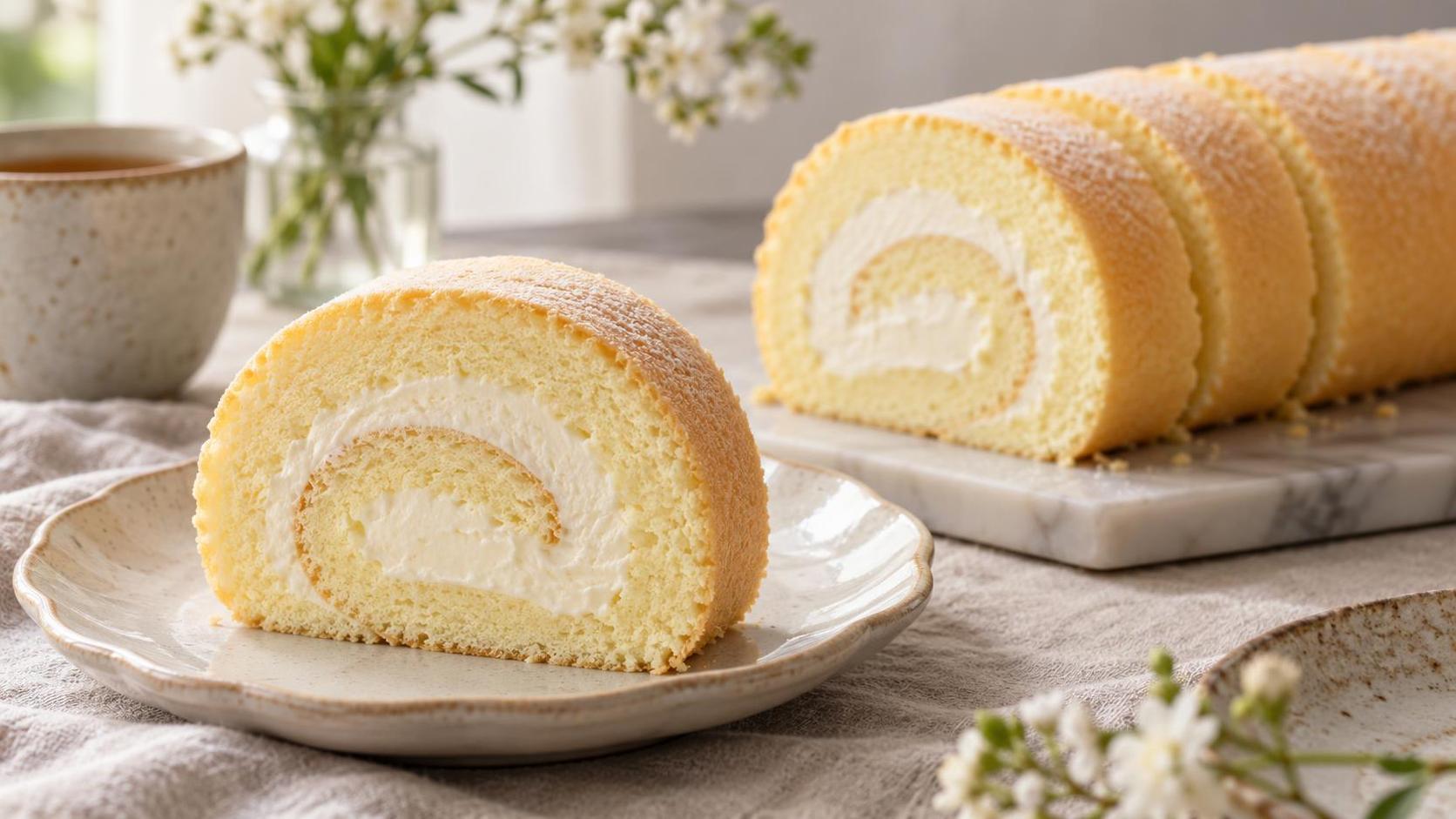
There is a specific kind of Swiss roll I grew up eating from the Chinese bakery — not the dry, spongy Western kind, but a cake so soft and moist it almost melts, wrapped around a thin ribbon of barely sweet cream. It came in a little box tied with string, and it was the treat I begged for whenever we went for buns and egg tarts.
Recreating that texture took me an embarrassing number of tries. My early rolls cracked the second I tried to curl them, splitting all the way along the top like they were offended by the whole idea. The problem was twofold: I was overbaking the sponge until it dried out, and I was letting it cool flat before rolling, so it had already set stiff.
The trick, I finally learned, is to bake a tender chiffon-style sponge just until set, then roll it up warm — with the parchment still attached — so it learns the curl while it is still soft. You let it cool in that rolled shape, then gently unroll, spread the cream, and roll it back up. It keeps the memory of the curve and does not fight you.
The result is that cottony, moist bakery roll I remember, and slicing into it still feels like a small victory. Keep the cream light — this cake is not about sweetness, it is about that impossibly soft texture.
At a glance
- Prep
- 25 min
- Cook
- 15 min
- Total
- 40 min
- Yield
- One roll (8 slices)
- Difficulty
- Medium
Ingredients
- **For the sponge:**
- 4 large eggs, separated, room temperature
- 50g caster sugar (for the whites)
- 30g caster sugar (for the yolks)
- 40g vegetable oil
- 50ml whole milk
- 1/2 tsp pure vanilla extract
- 70g cake flour
- 1/4 tsp cream of tartar
- Pinch of salt
- **For the filling:**
- 200ml cold heavy or whipping cream
- 2 Tbsp icing sugar
- 1/2 tsp pure vanilla extract
Method
-
Preheat the oven to 170°C (340°F). Line a 25 x 35 cm (about 10 x 14 inch) rimmed baking tray with parchment paper.
-
Whisk the egg yolks with 30g sugar until pale. Whisk in the oil, milk, and vanilla, then sift in the cake flour and whisk until smooth with no lumps.
-
In a clean, dry bowl, beat the egg whites with the cream of tartar and salt until foamy. Gradually add the 50g sugar and beat to soft-to-medium peaks — the tips should curl over, not stand stiff. Stiff whites make a sponge that cracks.
-
Fold the whites into the yolk batter in three additions, scooping from the bottom, until just combined with no streaks. Pour into the lined tray and spread level with an offset spatula. Tap the tray on the counter to release big bubbles.
-
Bake for 13 to 15 minutes, until the top is lightly golden and springs back when touched. Do not overbake — a dry sponge is what cracks.
-
Immediately turn the sponge out onto a fresh sheet of parchment. Peel off the baking parchment. While still warm, roll the sponge up loosely from the short end, with the fresh parchment inside, and let it cool completely in the rolled shape. This trains the curl.
-
Whip the cold cream with the icing sugar and vanilla to firm peaks. Gently unroll the cooled sponge, spread the cream evenly (a little thinner at the far end), then roll it back up snugly using the parchment to guide it.
-
Wrap the roll in the parchment and chill for at least 30 minutes to set. Trim the ends and slice with a clean, warm knife to serve.
Tips & Swaps
- Roll the sponge while it is still warm. A cooled, flat sponge has already set and will crack when you try to curl it.
- Beat the whites only to soft-medium peaks. Over-whipped whites give a stiff, crack-prone sponge rather than a cottony one.
- Do not overbake — pull the cake the moment it springs back. Extra minutes dry it out.
- Spread the cream a little thinner near the far end so it does not squeeze out when you finish rolling.
- Chill before slicing, and wipe the knife between cuts for clean bakery-style spirals.
Nutrition
Per serving · 1 slice
- Calories
- 180 kcal
- Fat
- 13 g
- Saturated fat
- 6 g
- Cholesterol
- 110 mg
- Sodium
- 60 mg
- Carbs
- 13 g
- Fiber
- 0 g
- Sugar
- 8 g
- Protein
- 4 g
Estimated values, calculated per serving. Actual nutrition varies with ingredients and portion sizes.
You might also like
 Cakes
Cakes Classic Baked Cheesecake
A tall, dense, creamy New York-style baked cheesecake with a buttery graham crust — no cracks, thanks to a low oven and a water bath.
 Cakes
Cakes Steamed Sponge Cake (Mom's Version)
Mom's bouncy, tender steamed sponge cake — the homey, everyday kind you eat with congee, not the fancy dim sum version. Made simple with pancake mix.